
Quick Answer: The primary difference between assisted living and memory care is the level of cognitive security and specialized dementia staffing. Assisted living supports seniors who are physically frail but cognitively alert, providing help with meals, personal hygiene, and medication reminders in an open residential setting ($4,800 to $5,800 per month). Memory care provides 24-hour secured perimeters, structured sensory routines, and a 1-to-5 staff ratio for individuals with Alzheimer’s or progressive dementia to prevent wandering and dangerous disorientation ($6,500 to $8,200 per month). When wandering risk or unmanaged confusion begins, assisted living is no longer safe.
You find yourself sitting at your parents’ kitchen table late on a Sunday evening, looking at three prescription bottles, a burned kettle, and an unpaid electric bill. Your mother insists she is managing fine, but her bruises tell a different story. Your father looks exhausted, carrying the silent weight of a spouse slipping into memory loss.
Moments like this force families into urgent research. You want to keep your aging parents safe, comfortable, and respected. Yet searching online quickly plunges you into high-pressure corporate broker websites and confusing medical jargon.
The choice between assisted living and memory care is rarely simple. It is an emotional fork in the road that balances personal independence against round-the-clock physical safety. This guide breaks down the clinical benchmarks, hidden billing structures, and safety differences between both care models so your family can make a confident, loving decision.
Key Takeaways
- Autonomy vs. Supervision: Assisted living preserves private apartment freedom; memory care provides a fully secured, wander-proof environment.
- Clinical Thresholds: Needing help with dressing or meals fits assisted living; disorientation to place, time, or safety hazards requires memory care.
- Staffing Ratios: Memory care communities maintain higher staff-to-resident ratios (typically 1:5) compared to standard assisted living (1:12 to 1:15).
- Cost Realities: Memory care averages 25% to 40% more than assisted living due to intensive staffing, specialized security, and all-inclusive care tiers.
- Independent Advice: Bilieter does not collect placement commissions. Our sole goal is helping your family navigate care transitions safely.
What Is Assisted Living? Independence with a Safety Net
Assisted living is a residential community designed for older adults who want to maintain an independent lifestyle but require help with daily physical routines. Residents live in private studio or one-bedroom apartments equipped with kitchenettes, emergency pull cords, and private bathrooms.
Staff members are available 24 hours a day to assist with what geriatricians term Activities of Daily Living (ADLs). These include personal hygiene, showering, buttoning shirts, transferring safely from bed to chair, and medication reminders. However, residents are free to manage their own schedules, join communal dining rooms, host visiting family, and participate in social outings.
Crucially, assisted living communities operate with open doors. Residents can walk out to the garden, visit the parking lot, or sign out for a day trip with family. For an aging parent who is mentally alert but physically vulnerable to falls, this environment provides community without compromising dignity.
What Is Memory Care? Specialized Security and Cognitive Support
Memory care is a specialized residential environment engineered specifically for individuals living with Alzheimer’s disease, vascular dementia, Lewy body dementia, or severe cognitive decline. It can exist as a dedicated standalone community or as a secured, self-contained wing within a broader senior living campus.
The core purpose of memory care is preventing harm caused by disorientation, wandering, and sensory overload. Exits are secured with silent keypad locks, coded elevator doors, and perimeter wander-management sensors. Hallways are intentionally built in continuous circular loops so walking residents never encounter dead ends or alarming locked doors.
Caregivers in memory care receive specialized training in dementia communication, behavioral redirection, and de-escalation techniques. Rather than rushing a confused resident through bathing, staff utilize sensory therapies, music cues, and familiar tactile routines to reduce anxiety and prevent combative agitation.
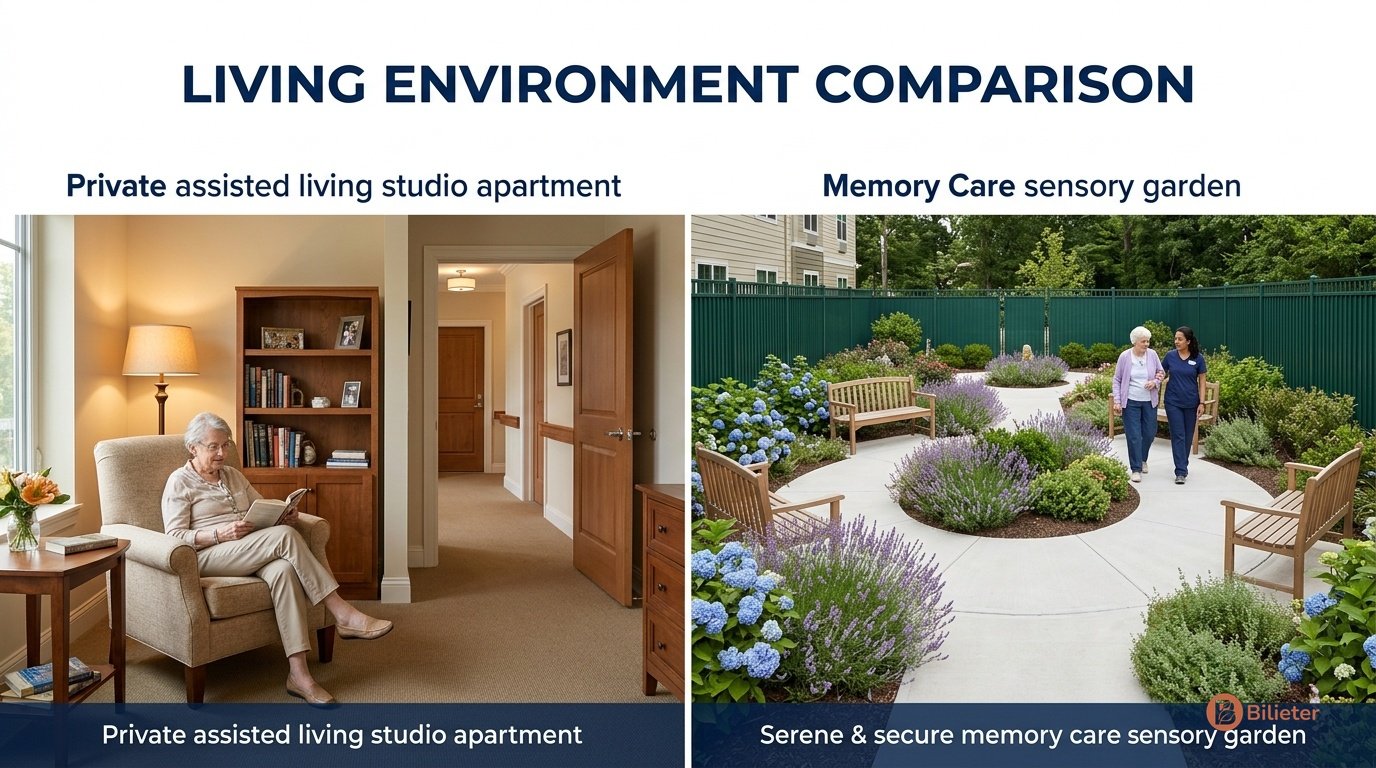
Figure 1: Assisted living emphasizes private apartment autonomy (left), while memory care integrates secured circular gardens and calming sensory architecture (right).
The Clinical Assessment: ADLs vs. IADLs
When eldercare consultants evaluate an older adult, they do not rely on subjective impressions. They measure two established geriatric categories: Activities of Daily Living (ADLs) and Instrumental Activities of Daily Living (IADLs), based on benchmarks established by the National Institute on Aging.
Understanding which category your parent struggles with clarifies which care model they actually need:
| Daily Function | Assisted Living Approach | Memory Care Approach |
|---|---|---|
| Bathing & Dressing | Scheduled assistance. Staff helps with zippers, buttons, or shower transfers on agreed days. | Step-by-step cueing. Staff guides resident through sensory washing without provoking agitation. |
| Medication Administration | Nurse visits apartment with pre-packaged med-passes or provides daily verbal reminders. | Direct supervised administration. Staff ensures pills are swallowed and tracks refusal behaviors. |
| Dining & Nutrition | Restaurant-style communal dining with menu choices. Residents walk to the dining room independently. | Adaptive dining. High-contrast plates, finger-food alternatives, and gentle pacing to encourage eating. |
| Physical Safety & Exits | Open doorways and exterior grounds. Resident is responsible for knowing their room and surroundings. | Secured magnetic perimeters, delayed-egress doors, and enclosed courtyards to prevent elopement. |
| Behavioral Management | Not equipped for wandering, sundowning, hallucination, or aggressive verbal outbursts. | Dementia-certified caregivers trained in gentle redirection, sensory grounding, and music cues. |
If your loved one needs physical assistance to stand, dress, or take blood pressure medication, assisted living handles those requirements smoothly. However, if they wake up at 2:00 AM convinced they must walk to a job they retired from thirty years ago, assisted living staff cannot legally lock them in their room.
Staffing Ratios and Dementia Caregiver Training
One of the most significant operational distinctions between these two options is staffing depth. Understanding staff ratios protects your parent from neglect during critical evening hours.
In standard assisted living, the daytime caregiver-to-resident ratio typically ranges from 1:12 to 1:16. During overnight shifts, that ratio often widens to 1:25 or higher. While emergency alert pendants connect to on-duty staff, response times can take several minutes if caregivers are assisting another resident with a complex bathroom transfer.
In contrast, state regulations and clinical standards require memory care wings to maintain much tighter supervision. Daytime ratios average 1:5 to 1:7, with overnight staffing rarely exceeding 1:10. Caregivers stay physically present inside common gathering spaces rather than sitting behind remote nurse desks.
Furthermore, memory care staff undergo mandatory continuing education in dementia progression. They learn that combative resistance during a shower is rarely stubbornness; it is often sheer terror caused by water hitting hypersensitive skin. Caregivers learn to adjust water pressure, warm towels beforehand, and sing familiar songs to soothe distress.
Figure 2: Summary decision matrix comparing personal autonomy, safety architecture, and monthly budget tiers.
The Financial Breakdown: Base Rent, Care Points, and Hidden Fees
Senior care pricing is notoriously complex. Referral broker sites often quote broad national medians that mislead families during the budgeting process. According to the Genworth Cost of Care Survey and data from Medicare.gov, private long-term senior housing requires clear financial planning.
Here is what families actually pay when the monthly invoice arrives:
1. Assisted Living Pricing Models
Most assisted living facilities charge a “base rent” that covers the apartment, three meals daily, utilities, housekeeping, and maintenance. Across the United States, base rent averages $4,500 to $5,500 per month.
However, personal care is rarely included in the base rate. Facilities use a “Tiered Care” or “Point System” assessment:
- Level 1 Care (Minimal): Standby shower assistance and weekly laundry ($400 to $700/month).
- Level 2 Care (Moderate): Daily dressing help, hygiene assistance, and escorted walks to meals ($800 to $1,400/month).
- Level 3 Care (Extensive): Incontinence management, full transfer support, and two-person assists ($1,500 to $2,500+/month).
- Medication Management: Billed separately based on the number of daily medication passes ($350 to $750/month).
2. Memory Care Pricing Models
Memory care is more expensive due to low staffing ratios, specialized architectural security, and intensive programming. Nationally, memory care costs between $6,500 and $8,500 per month.
Unlike assisted living, many reputable memory care communities utilize an “all-inclusive” billing structure. This bundles housing, meals, personal hygiene, incontinence support, and medication management into a single predictable monthly invoice. This model shields families from sudden care tier price spikes as dementia symptoms advance.
3. Hidden Gotchas to Check Before Signing
Before committing to any facility contract, ask the admissions director for their fee schedule in writing:
- Community Move-In Fee: A one-time non-refundable fee ($2,500 to $6,000) collected on move-in day.
- Annual Escalation Clauses: Most private communities increase base rates by 5% to 8% every January.
- Incontinence Supply Surcharges: Facilities often mark up wipes, barrier creams, and disposal fees if you do not supply them yourself.
- Emergency Hospital Escort Fees: If your parent rides an ambulance to the ER, staff members accompanying them may bill hourly rates ($50/hour).
5 Clear Signs It Is Time to Transition from Assisted Living to Memory Care
Many aging parents begin their senior living journey in assisted living. But dementia is progressive. Recognizing when standard assisted living can no longer protect your parent is essential to preventing preventable tragedy.
Look for these five definitive behavioral indicators:
1. Elopement Risk and Wandering Behaviors
If your parent is found wandering near exterior exits, attempting to open emergency stairwell doors, or expressing a repetitive compulsion to “walk home,” assisted living is no longer viable. In an unsecured facility, an elopement event can lead to traffic accidents or severe hypothermia within minutes.
2. Severe Sundowning and Overnight Agitation
Sundowning is a clinical phenomenon where confusion, anxiety, and pacing intensify as natural daylight fades. If an older adult becomes combative at dusk, wanders into other residents’ apartments at 3:00 AM, or accuses staff of theft, the light overnight staffing of assisted living cannot manage their distress.
3. Unmanaged Incontinence and Hygiene Neglect
When cognitive decline prevents an adult from recognizing the sensation of a full bladder or understanding how to operate bathroom plumbing, skin breakdown and recurrent urinary tract infections (UTIs) escalate. The CDC STEADI Older Adult Safety Program highlights that untreated infections drastically increase fall rates.
4. Weight Loss and Eating Apraxia
In advanced dementia, individuals often forget how to use silverware or fail to recognize food placed in front of them. If assisted living staff notice your parent leaving full trays untouched because they cannot initiate the motor process of eating, they require hands-on cueing in memory care.
5. Unsafe Reactions to Emergencies
Ask yourself: If the fire alarm sounded in the building at 2:00 AM, would your parent know how to exit safely? If the answer is no, an open assisted living setting poses an unacceptable life safety hazard.
Verbatim Conversation Scripts: Talking with Parents and Siblings
Care transitions trigger enormous emotional resistance. Aging parents fear losing their dignity; adult children feel consumed by guilt; siblings argue over finances and diagnosis severity. Using calm, non-accusatory language softens defensiveness.
What to Say to an Aging Parent Who Refuses Help
Avoid: “Mom, you can’t live alone anymore. You’re forgetting your pills and you fell last week.”
Say Instead: “Mom, I love you too much to worry about you being alone if you ever felt dizzy at night. I want you to have friendly people around to cook your favorite meals and handle the laundry so you can enjoy your mornings without stress. Let’s visit a place together just to have lunch and see how the gardens look.”
What to Say to a Sibling in Denial About Dementia Symptoms
Avoid: “You live three states away and have no idea how bad Dad is getting. You need to sign these papers.”
Say Instead: “I know how hard it is to see Dad changing. Because I am here with him during the evenings, I am noticing moments where he doesn’t recognize our street or forgets to turn off the burner. I need your partnership. Could you join me on a video call with his neurologist this Thursday so we can hear the doctor’s safety assessment together?”
Frequently Asked Questions
Does Medicare pay for assisted living or memory care?
Medicare does not pay for custodial long-term senior housing, whether in assisted living or memory care. Medicare only covers short-term rehabilitative skilled nursing (up to 100 days post-hospitalization), physician visits, and qualifying hospice care. Long-term room and board must be funded through private savings, long-term care insurance, or state-specific Medicaid waiver programs if assets qualify.
Can a married couple live together if one has dementia and the other does not?
Yes. Many comprehensive senior care campuses offer hybrid living arrangements. Spouses can share an assisted living apartment while the partner with memory loss attends specialized day programming in the memory wing. Alternatively, both can reside in assisted living with supplemental private in-home dementia aides until 24-hour security becomes mandatory.
What is the average length of stay in memory care?
According to the Alzheimer’s Association, the average stay in a memory care community is between two and three years. However, duration varies widely based on the resident’s physical health, age at diagnosis, and mobility status.
Can an assisted living facility evict a resident with dementia?
Yes. If an assisted living community determines that a resident’s wandering, combative behaviors, or physical needs exceed the state regulatory licensing of the facility, they can issue a formal 30-day notice of discharge. Moving proactively to memory care prevents the panic of an emergency discharge.
What should we look for during an unannounced facility tour?
Visit during mealtime or between 4:00 PM and 6:00 PM (peak sundowning hours). Observe whether residents in common areas look clean and engaged or slumped over asleep in wheelchairs. Check for chemical masking odors in hallways, test the friendliness of frontline aides, and ask to see the monthly activity calendar for specialized dementia programs.
Your Actionable Next Steps This Week
Making a care transition is a process of small, deliberate decisions. You do not need to solve everything today. Focus on three constructive steps over the next seven days:
- Schedule an Objective Geriatric Assessment: Contact your parent’s primary physician or a local memory clinic for an updated cognitive evaluation (such as the MoCA test) and a functional ADL screening.
- Audit Family Finances and Paperwork: Confirm that you have active Durable Power of Attorney (financial and medical) documents signed before cognitive capacity declines further. Review our guides on About Us and our Editorial Policy & Care Standards to understand how we review care standards.
- Tour Two Communities Without Your Parent: Visit one assisted living facility and one specialized memory care wing in your local area. Experiencing the physical environments firsthand will clarify which level of support feels right for your family.
If you have questions about specific facilities, caregiving burnout, or legal planning, reach out directly through our Contact Us page. You are not alone on this caregiving journey.
Medical & Legal Disclaimer: The information provided in this guide is for educational and informational purposes only. It does not constitute formal medical diagnosis, clinical treatment, or personalized elder law counsel. Consult a qualified physician for healthcare decisions and a licensed elder law attorney for legal and estate planning.
Written by Franklin Alfano, Senior Care & Eldercare Operations Consultant at Bilieter. Franklin reviews senior care environments, assistive safety technology, and family care frameworks to help adult children make confident, loving care decisions.