

Growth is the ultimate goal for any UAE startup, but in the fast-paced ecosystem of Dubai and Abu Dhabi, growth is also where the most significant risks lie. It is an exhilarating phase, characterized by rising user numbers, expanding teams, and market buzz. However, from a financial perspective, scaling is often where founders lose control.
The harsh reality is that scaling without absolute financial clarity leads to rapid cash burn, reactive decision-making, and missed market opportunities. Many founders believe that more revenue will solve their problems, but if your unit economics are broken, more revenue simply means you are losing money faster. This is why financial success during a growth spurt depends on strategic leadership rather than just basic compliance. To navigate this, many forward-thinking founders are turning to cfo accounting services not merely to keep the books balanced, but to act as a strategic compass before the chaos of scaling begins.
In this guide, we will explore why the “pre-scaling” phase is the most critical time to transition from simple bookkeeping to strategic financial leadership, and how a fractional CFO provides the infrastructure necessary for sustainable success.
Why Scaling Is the Most Dangerous Phase for Startups?
There is a common illusion in the startup world: that revenue growth is a proxy for health. In reality, scaling is the phase where underlying weaknesses are amplified.
The Revenue vs. Profitability Trap
When you scale, your “burn rate” often accelerates faster than your “collectible” revenue. You might be signing contracts, but if your payment terms are 60 days and your payroll is due every 30, you face a liquidity crisis.
Key problems that emerge include:
- Cash Flow Gaps: Even with a full sales pipeline, the timing of cash inflows and outflows becomes erratic.
- Rising Operational Complexity: What worked for a team of five fails for a team of fifty. Overhead costs begin to “leak” capital.
- Margin Erosion: As you chase market share, marketing costs and discounts often eat into your gross margins, sometimes leaving you with a negative contribution margin per customer.
Founders often feel a specific type of pain: “We are hitting our sales targets, so why is the bank account always empty?” These issues don’t start at scale; they are baked into the business long before the growth curve hits.
The Real Problem: Startups Operate Without Financial Strategy
Most startups have an accountant, but very few have financial leadership. It is vital to distinguish between these two functions.
Accounting is historical. It looks backward to ensure you are compliant, your VAT is filed, and your past transactions are recorded. It tells you where your money went.
Financial Leadership (CFO-level) is forward-planning. It looks at where your money should go. It involves forecasting, capital allocation, and risk mitigation.
In most UAE startups, there is a glaring strategy gap. There are no multi-year forecasts, no clearly defined Key Performance Indicators (KPIs), and no framework for making capital-intensive decisions. Numbers exist in a spreadsheet, but they don’t guide the CEO’s daily actions.
What Breaks When You Scale Without a CFO?
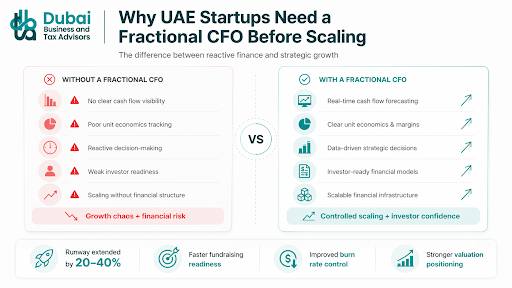
Without a steady hand on the financial tiller, scaling usually leads to one of four “breakages.”
Cash Flow Chaos
Growth requires upfront investment inventory, software licenses, or talent. If you don’t have a working capital strategy, you risk “growing yourself into bankruptcy.” A CFO ensures that your cash runway is managed with surgical precision.
Hiring Without Financial Clarity
One of the biggest expenses for UAE startups is talent. Founders often hire based on “feeling” busy rather than on a cost-to-revenue alignment. Scaling without a CFO leads to over-hiring in the wrong departments, creating a bloated cost base that is hard to trim later.
Pricing & Margin Blind Spots
Do you know your Customer Acquisition Cost (CAC) versus your Lifetime Value (LTV)? Scaling a business with a weak LTV/CAC ratio is like pouring water into a leaky bucket. A CFO uncovers these blind spots, ensuring your pricing strategy actually supports a profitable business model.
Investor Readiness Gaps
When the time comes to raise a Series A or B, investors look for “financial storytelling.” If your data is messy or your projections are unrealistic, you lose credibility. A lack of institutional-grade reporting is the number one reason UAE startups fail at due diligence.
What a Fractional CFO Actually Does? (Beyond Accounting)
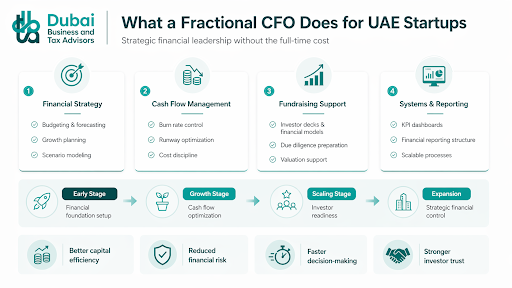
A fractional CFO is not just a “senior accountant.” They are a strategic partner who works a few days a month to provide high-level expertise at a fraction of the cost of a full-time hire.
Their core responsibilities include:
- Financial Forecasting: Building dynamic models that show how different growth scenarios affect your cash position.
- KPI Tracking & Dashboards: Creating visual tools that allow founders to see the health of the business at a glance.
- Scenario Analysis: Asking “What if?” What if our lead acquisition cost doubles? What if a major client leaves?
- Fundraising Support: Preparing the pitch deck’s financial section and handling technical questions from VCs.
Why Startups Need a CFO BEFORE Scaling?
The biggest misconception is: “We’ll hire a CFO once we’re big.” This is like trying to install a foundation after the house is already built.
Bringing in cfo accounting services early allows you to set up scalable systems when the stakes are lower. It is much easier to fix a pricing model or a chart of accounts when you have ten employees than when you have a hundred. Early clarity leads to controlled growth; waiting leads to reactive, “fire-fighting” decision-making.
UAE-Specific Financial Challenges Startups Must Prepare For
Operating in the UAE adds layers of complexity that a generalist might overlook.
- Corporate Tax (CT): With the 9% corporate tax regime now in full swing, startups must optimize their structures early to remain tax-efficient.
- VAT Compliance: Scaling usually means crossing the mandatory VAT registration threshold. Missing this or filing incorrectly leads to hefty FTA penalties.
- Free Zone vs. Mainland: As you scale, you may need to move from a Free Zone to a Mainland license to bid on certain contracts. This has massive implications for your financial structure and ownership.
- Multi-Entity Expansion: Many UAE startups scale into Saudi Arabia or Egypt. Managing cross-border transfer pricing and currency risk requires expert-level planning.
Pre-Scaling Financial Readiness Checklist
Before you hit the “accelerate” button, ask yourself these six questions:
- Do you have a rolling 12-month financial forecast?
- Do you know your exact cash runway (down to the week)?
- Are your unit economics (margins per product/service) clear and positive?
- Are you tracking non-vanity KPIs (like Burn Multiple or Payback Period)?
- Is your pricing strategy backed by hard data or just “market feel”?
- Are your accounting systems automated and capable of handling 5x the volume?
If the answer to more than two of these is “no,” you are not ready to scale.
Fractional CFO vs. Full-Time CFO vs. Accountant
| Role | Primary Focus | Best For |
| Accountant | Compliance, Tax, & History | Day-to-day bookkeeping. |
| Fractional CFO | Strategy, Forecasting, & Scaling | Startups and SMEs needing expert guidance without the $200k+ salary. |
| Full-Time CFO | Long-term Leadership & M&A | Mature companies with massive internal teams. |
Cost vs. Value: Is a Fractional CFO Worth It?
Founders often balk at the “extra cost” of a CFO. However, the cost of a single bad decision like over-committing to a long-term office lease or mispricing a major contract is far higher than the monthly retainer for a fractional expert.
The ROI of a CFO is found in what doesn’t happen:
- You don’t run out of cash unexpectedly.
- You don’t fail your audit.
- You don’t accept a “down round” of funding because your data was weak.
Expertise is a profit-protection mechanism, not a luxury expense.
Common Misconceptions
- We’re too early for a CFO.If you have a product in the market and are spending money, you aren’t too early for strategy.
- Our accountant is enough.Accountants are great at what they do, but they aren’t trained to build 5-year growth models or negotiate with VCs.
- It’s an unnecessary cost.Strategic financial advice usually identifies enough cost-savings or revenue-leakage to pay for itself.
How to Know It’s Time to Bring in a Fractional CFO
It’s time to seek professional support if:
- You are preparing for a seed or Series A funding round.
- Your cash flow feels like a “black box” . You aren’t sure why the balance is changing.
- You are making major decisions (like international expansion) based on gut feeling.
- You are spending more time on spreadsheets than on product development.
Frequently Asked Questions
What is a fractional CFO?
A fractional CFO is a senior finance executive who works with your startup part-time or on retainer. You get board-level financial strategy fundraising, cash flow, investor reporting at a fraction of the cost of a full-time hire. In Dubai, a full-time CFO costs AED 40,000–80,000/month. A fractional CFO typically runs AED 8,000–20,000/month with no visa or gratuity obligations.
Why hire one before scaling, not after?
Scaling amplifies your existing financial foundation, good or bad. Messy books, incorrect VAT filings, or a burn rate that doesn’t match your investor model become far more expensive to fix once growth has built on top of them. A fractional CFO puts the right systems in place before you accelerate, not after the damage is done.
Can’t our accountant handle this?
Accountants manage the past recording transactions and keeping you compliant. A fractional CFO manages the future building financial models, forecasting runway, preparing for fundraising, and advising on strategic decisions. Both are necessary, but they serve completely different purposes. Confusing the two is one of the most common and costly mistakes early-stage founders make.
What UAE-specific challenges does a fractional CFO help navigate?
The UAE has a complex and fast-evolving compliance landscape. A fractional CFO helps you stay on top of the 9% corporate tax introduced in 2023 (including free zone exemptions), VAT registration and quarterly filing, Economic Substance Regulations, DIFC or ADGM audit requirements, and Ultimate Beneficial Ownership disclosures. Getting any of these wrong carries real financial and reputational penalties.
How does a fractional CFO improve your chances of raising funding?
Investors do serious due diligence. A fractional CFO ensures your financial model is defensible, your historical accounts are clean, your data room is organised, and your revenue is booked correctly under IFRS standards. Many UAE founders discover mid-fundraise that their financials don’t tell the story investors expect which delays or kills rounds entirely. A fractional CFO prevents that.
Conclusion:
Scaling doesn’t solve underlying problems,it amplifies them. If your financial foundation isn’t solid, growth will only expose the gaps faster and at a higher cost.
Financial clarity isn’t something startups can delay until they reach scale; it’s what makes sustainable growth possible in the first place. Bringing in the right financial expertise early ensures that every dirham is allocated with purpose, every decision is backed by data, and every step forward is controlled and not reactive.
With the support of Dubai Business & Tax Advisors, startups can move beyond guesswork and build a financial strategy designed for long-term success. Growth should never be left to chance,it should be guided by insight, structure, and the confidence that comes from making the right decisions at the right time.